
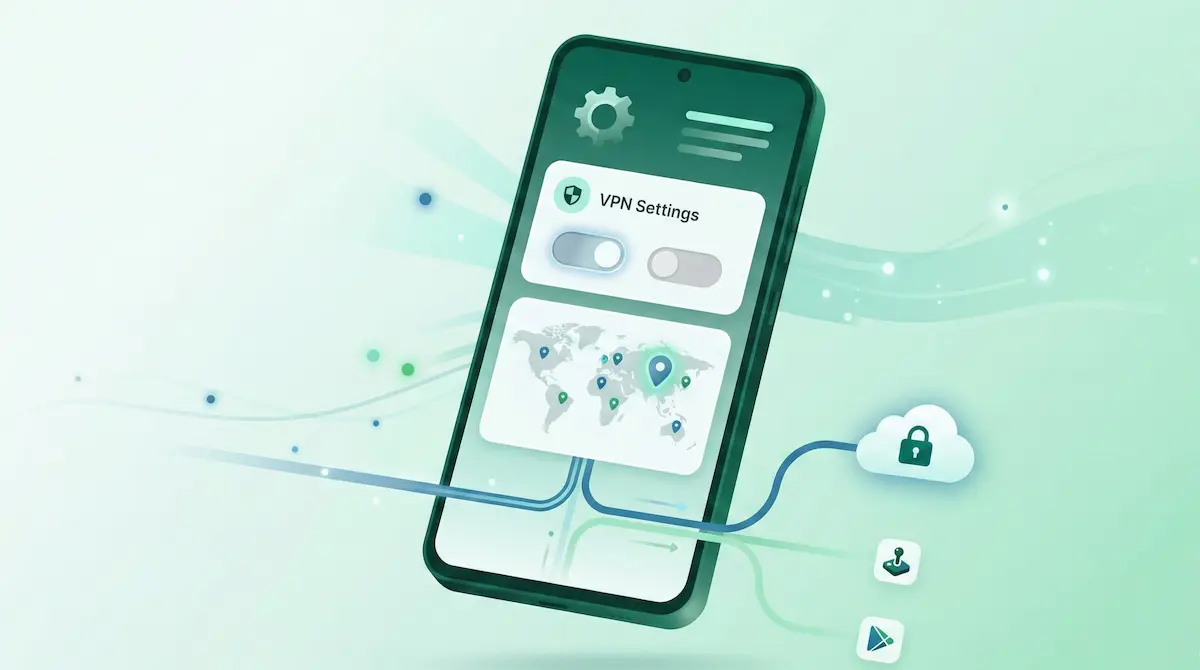
Best VPN Settings for Android: Simple Setup Guide (2026)
Most Android VPN apps include several configuration options. For new users, these settings can feel confusing. In practice, however, only a few settings matter for everyday use.
A typical VPN setup involves choosing a protocol, selecting a server location, and deciding whether certain apps should bypass the VPN. Once those basics are configured, the connection usually works reliably on most networks.
The goal of this guide is to simplify the process. Instead of adjusting many advanced settings, you will learn a practical baseline configuration that works well in daily use.
We will also cover when to change those settings—for example on public WiFi, restrictive networks, or when specific apps behave differently with VPN enabled.
Quick Summary
- Most users only need to configure protocol, server location, and optional split tunneling.
- Start with WireGuard and switch protocols only if connections fail.
- Choose a nearby server location for everyday use.
- Leave Split Tunneling disabled until you need app-specific routing.
- Reconnect the VPN after changing settings.
- On public WiFi, connect after completing the network login page.
- Avoid changing multiple settings at once while troubleshooting.
What “VPN settings” actually mean on Android
When people talk about VPN settings on Android, they usually refer to a few basic configuration options inside the VPN app.
The most important ones include:
Protocol choice
Defines how the VPN connection is established and encrypted.
Server location
Determines which region your device connects through.
Split tunneling
Controls which apps use the VPN and which connect directly.
DNS behavior
Handles how domain names are resolved while the VPN is active.
Connection stability settings
Some apps include options related to background operation or network behavior.
For most users, only the first three—protocol, server location, and split tunneling—require occasional adjustment.
Recommended basic VPN setup (simple baseline)
A simple configuration works well for most Android users.
Baseline configuration
- Protocol: WireGuard
- Server location: nearest region
- Split tunneling: off initially
- Private DNS: automatic
- Battery optimization: disabled for the VPN app
Why this setup works
WireGuard as the default
WireGuard is widely supported and typically stable on normal networks.
Nearest server location
Shorter distance often improves connection stability.
Split tunneling disabled
Starting with full-device routing avoids app-specific compatibility issues.
Battery optimization disabled
Android battery management can sometimes pause background connections.
This baseline configuration works well on most home networks and mobile connections.
Choosing the right VPN protocol
Android VPN apps may support multiple protocols. The two most relevant here are:
WireGuard
- Good default for everyday use
- Works well on typical home and mobile networks
- Simple configuration
XRay (VLESS/Reality)
- Sometimes more compatible with restrictive networks
- Useful when certain WiFi networks block VPN traffic
Practical guideline
Start with WireGuard.
Switch to XRay (VLESS/Reality) if:
- VPN fails to connect
- WiFi network appears restrictive
- frequent disconnects occur on specific networks
Protocol switching is primarily a compatibility tool. It does not guarantee faster speeds.
Choosing the right server location
Server location can influence connection stability and responsiveness.
A few simple rules help keep configuration straightforward.
Choose the nearest region first
Shorter physical distance usually improves stability.
Try another nearby region if needed
If connection fails or behaves strangely, testing another nearby location can help.
Avoid changing multiple variables
When troubleshooting, change either the server location or the protocol—not both at the same time.
When to enable Split Tunneling
Split tunneling allows certain apps to bypass the VPN while others remain connected.
This can help resolve compatibility problems with specific apps.
Examples:
VPN only for one app
Useful if you only need VPN for a particular service.
Exclude banking apps
Some financial apps behave differently when a VPN is active.
Exclude streaming apps
Streaming platforms sometimes work better without VPN routing.
Work apps inside VPN
Communication or work apps may benefit from VPN routing while other apps connect normally.
Start with split tunneling disabled, then enable it only when needed.
Settings for public WiFi networks
Public WiFi networks behave differently from home internet connections.
Common examples include:
- cafes
- hotels
- airports
- coworking spaces
Recommended setup:
- Connect to WiFi first.
- Complete the login page (captive portal).
- Confirm internet access.
- Enable the VPN.
If the VPN fails on public WiFi:
- switch protocols
- reconnect after login
- test a nearby server
Settings for restrictive networks
Some networks restrict VPN traffic. This can happen on:
- school WiFi
- office networks
- managed public networks
If connections fail on these networks:
- switch to XRay (VLESS/Reality)
- test another server location
- reconnect after network login pages
Testing one setting at a time helps identify the real cause.
Android TV setup tips
VPN setup on Android TV is similar to phones.
Key points:
- use nearby server locations
- keep configuration simple
- reconnect after WiFi login pages
Some travelers use Android TV devices in hotels or shared networks. The same troubleshooting steps usually apply.
NimbusVPN supports Android TV with a remote-friendly interface, making configuration easier on television devices.
Common mistakes with VPN settings
A few common mistakes can cause unnecessary troubleshooting.
Changing multiple settings at once
This makes it difficult to identify which change fixed the problem.
Choosing distant server locations unnecessarily
Far servers may increase instability.
Forgetting to reconnect after changing settings
Many configuration changes require reconnecting the VPN.
Testing VPN before completing captive portal login
Hotel or airport networks often block internet until login is completed.
Keeping configuration simple avoids most problems.
Simple troubleshooting workflow
If something goes wrong, adjust settings in a logical order.
1. VPN connects but no internet
Check:
- Private DNS settings
- captive portal login pages
- server location
2. VPN fails on WiFi
Try:
- switching protocols
- reconnecting WiFi
- testing mobile data
3. One app fails on VPN
Use:
- Split Tunneling
- app cache reset
4. Frequent disconnects
Check:
- server location
- WiFi stability
- battery optimization settings
Changing one setting at a time helps identify the cause quickly.
FAQ
What is the best VPN protocol for Android?
WireGuard is usually a good default. On restrictive networks, switching to XRay (VLESS/Reality) may improve compatibility.
Should I always use the nearest server?
For everyday use, yes. Nearby servers usually provide the most stable connections.
Does split tunneling improve speed?
Split tunneling mainly improves compatibility with specific apps rather than guaranteeing faster speeds.
Why does VPN work on mobile data but not WiFi?
Some WiFi networks apply restrictions or filtering that interfere with VPN traffic.
Should I disable Private DNS?
Usually it can remain enabled. If VPN issues occur, temporarily disabling it can help diagnose DNS conflicts.
What settings help on hotel WiFi?
Complete the WiFi login page first, then enable VPN and choose a nearby server.
Why do some apps fail when VPN is on?
Some apps behave differently when traffic is routed through VPN. Split tunneling can help.
Do Android TVs use the same VPN settings?
Yes. Protocol choice, server location, and split tunneling apply to Android TV devices as well.
How NimbusVPN fits
NimbusVPN provides a simple set of controls for Android VPN configuration:
- Supports WireGuard and XRay (VLESS/Reality) protocols
- Includes Split Tunneling for app-specific routing
- Works on Android TV with a remote-friendly interface
- Designed for straightforward Android setup
- Allows protocol testing on restrictive networks
If you want a VPN app that lets you adjust protocol and routing when needed, NimbusVPN offers those tools within a simple Android interface.
Related articles to write next
- VPN Not Working on WiFi (Android Fix Guide)
- VPN Connected but No Internet on Android
- WireGuard vs XRay (VLESS/Reality) on Android