
The right question is not just “free or paid?”
When people ask whether a free VPN is safe, they are usually asking a better hidden question:
What am I giving up if I do not pay?
That tradeoff may be money, but it can also be:
- ads,
- account friction,
- unclear data practices,
- weak protocol choice,
- misleading marketing around “unlimited privacy.”
So the useful distinction is not simply free vs paid. It is credible free VPN vs low-trust free VPN.
Signs that a free VPN may be worth trying
No account wall before first value
If you can install the app and test a connection quickly, the product is already behaving more honestly. This is one reason a no-account Android VPN is easier to evaluate.
Clear protocol story
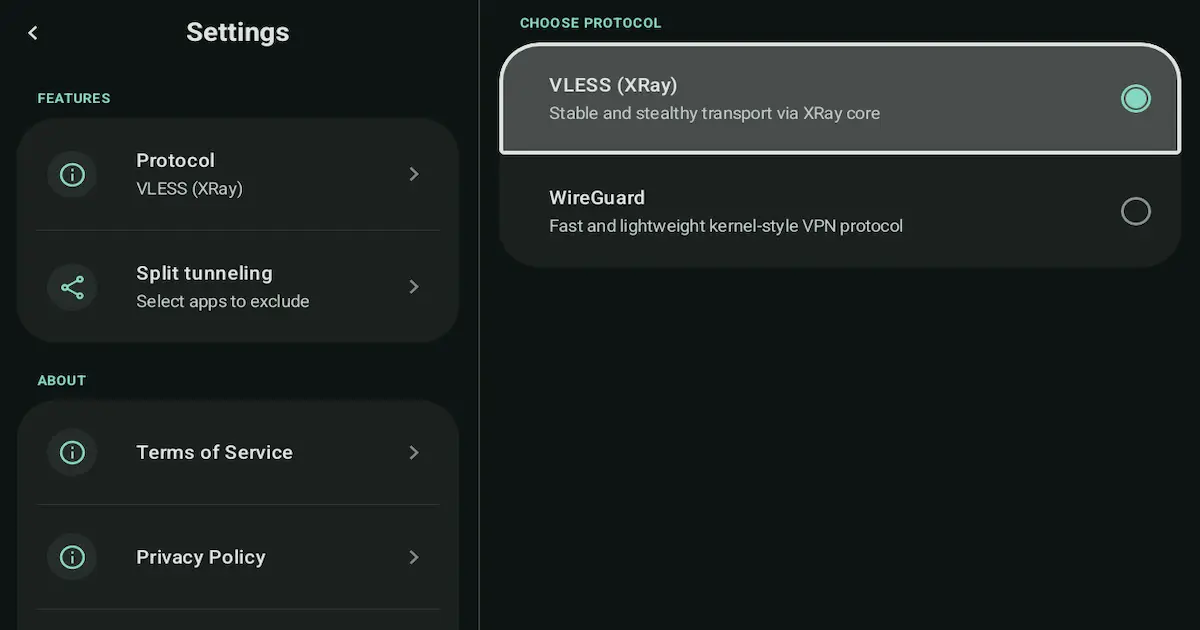
A free VPN that offers no meaningful protocol explanation is harder to trust. Modern Android users benefit from understanding at least the basic difference between WireGuard and XRay (VLESS).
Practical Android-first features
If the product includes split tunneling, Android TV support, or sensible always-on guidance, that usually signals a team that is building for real Android usage instead of just cloning a generic landing page.
Warning signs to watch for
Heavy ad pressure
Ads are not automatically proof of malicious intent, but ad-heavy privacy tools create tension. If the app is built around interrupting the user, that undermines trust fast.
Confusing limits
Some free VPNs technically work, but the real free tier is buried under speed caps, queue systems, or misleading language.
Weak transparency
If the product gives no clear signal about how it is funded, what protocols it uses, or why it is free, caution is reasonable.
When a free VPN is probably enough
A credible free VPN can already be enough if your goal is:
- protecting public Wi-Fi,
- testing a VPN workflow on Android,
- adding a privacy layer for daily browsing,
- using a travel fallback on hotel or airport networks.
That is why the more practical question is whether the VPN solves your workflow cleanly. If it does, “free” is not automatically a red flag.
When paid still makes sense
Paid becomes more attractive when you want:
- wider long-term server coverage,
- advanced enterprise or family features,
- dedicated support expectations,
- a business model already stabilized around subscriptions.
If you are deciding between the two, read free vs paid VPN on Android.
How NimbusVPN fits the safety question
NimbusVPN’s current free model is easiest to understand as a growth and infrastructure phase:
- no account required,
- no ad SDK messaging,
- Android-focused setup,
- protocol flexibility,
- transparent legal pages.
That does not mean every free VPN is safe. It means the safety test should focus on product behavior, not just the price label.
Final checklist before installing a free VPN
Ask these questions:
- Can I test it quickly without handing over personal data?
- Does the app explain how it routes traffic?
- Does it avoid aggressive ad-driven behavior?
- Does it support real Android use cases like split tunneling or protocol fallback?
- Does the website feel like a real product ecosystem instead of a thin acquisition shell?
If the answers are mostly yes, a free VPN can be a reasonable choice. If the answers are vague, “free” may be the least important problem.